
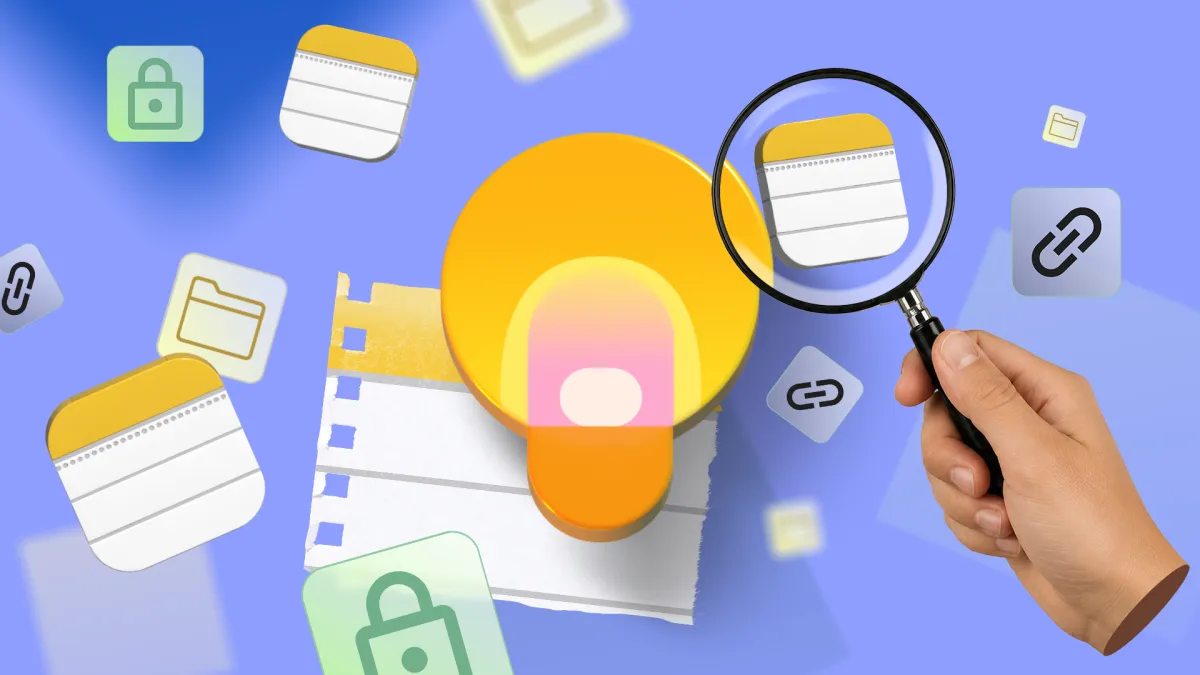
A daily Google Keep user is calling out the features Apple Notes offers that Google’s rival app still has not matched.
Google Keep remains a go-to tool for fast, low-friction note capture — grocery lists, quick reminders, article ideas, fleeting thoughts — but Apple’s competing app has pulled ahead in several specific areas.
Where Apple Notes Leads
Apple Notes supports nested folders, letting users organize notes inside sub-folders inside sub-folders with no practical limit.
Google Keep, by contrast, relies on labels — a flat tagging system that works well for simple sorting but breaks down when a user’s note volume grows.
Apple Notes also offers a document scanner built directly into the app, using the iPhone camera to capture, straighten, and store physical documents without leaving the interface.
Keep lacks a native scanner, Pushing Users Toward Google Drive or Google Lens for the same task.
Formatting and Search
Apple Notes supports checklists, tables, rich text formatting, and handwritten notes — all within a single note.
Keep handles checklists well but does not support tables or freeform mixed-content layouts in the same way.
Apple’s search inside Notes can locate text within scanned documents and handwritten entries, a function tied to Apple’s on-device optical character recognition (OCR) — the process of converting image-based text into searchable characters.
That depth of search gives Apple Notes users a meaningful practical edge when retrieving older material.
Collaboration and Locking
Apple Notes allows users to lock individual notes behind Face ID, Touch ID, or a custom password.
Keep offers no per-note locking, meaning any note is visible to anyone who unlocks the phone.
Still, Keep does allow real-time note sharing and collaboration with other Google accounts, a feature Apple Notes also supports.
Both apps let multiple users edit a shared note simultaneously.
Where Keep Still Wins
Keep’s core advantage remains speed and cross-platform reach.
It runs on Android, iOS, and every major web browser, and it syncs across all of them without friction.
Apple Notes ties most of its advanced features to Apple hardware, limiting their use for anyone working across mixed-device environments.
Keep also surfaces notes as home screen widgets on Android more flexibly than Apple Notes does on iOS, making glanceable reminders quicker to access without opening the app.
Color-coded notes and a visual card-based grid — Keep’s default layout — Give Users a faster at-a-glance scan of their content than Notes’ list-based interface.
Background
Google launched Keep in March 2013 as a lightweight alternative to more complex note apps such as Evernote.
Apple Notes shipped as a basic app for years before Apple began expanding it significantly with iOS 9 in 2015, adding formatting, sketching, and attachment support.
Since then Apple Has continued adding features to Notes with each major iOS release, while Keep’s development pace has remained comparatively modest.
-
-

-

-

-
-

-

-

