
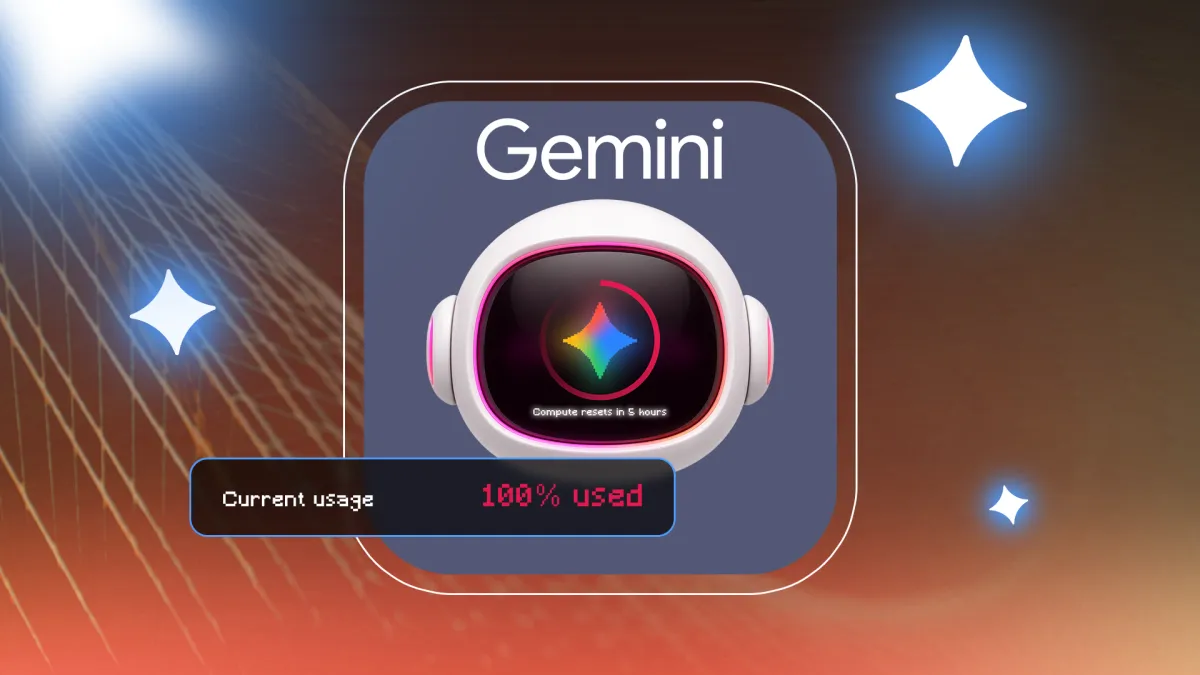
Google’s Gemini AI assistant has begun hitting usage limits that interrupt tasks mid-session, prompting users to question whether it can serve as a dependable daily tool.
The frustration reflects a broader shift in expectations since OpenAI launched ChatGPT in late 2022 — a moment that set a baseline of near-constant availability across AI platforms.
A Market Built on Reliability
For close to four years, Users Have toggled between AI assistants from Google, OpenAI, Anthropic, and others with little interruption, building daily workflows around the assumption that these tools simply work when called upon.
That assumption now faces pressure, at least on Google’s platform.
Gemini’s compute throttling — the practice of capping how much processing a user can consume within a given window — surfaces most acutely during complex, multi-step tasks, the kind that make an AI assistant genuinely useful rather than merely novelty.
Still, Google is not alone in managing server load. Every major AI provider applies some form of rate limiting, particularly on free tiers.
By contrast, the concern with Gemini centers on whether those limits intrude at a frequency and severity that breaks trust — the quality users need most from an assistant they plan to rely on daily.
Trust Is the Real Product
An AI assistant earns its place in a workflow not through flashy features but through consistency.
When a tool fails mid-task, users do not simply retry — they route around it, and habit forms fast.
OpenAI’s ChatGPT and Anthropic’s Claude have each built substantial user bases partly by maintaining session continuity and offering clear, predictable tier structures that tell users What They can expect before limits kick in.
Google, by contrast, markets Gemini as deeply integrated across its ecosystem — Android, Gmail, Docs, Search — which raises the stakes for any reliability gap considerably.
If Gemini stumbles during a Docs edit or drops context inside Gmail, the failure is not isolated to a chat window; it ripples across the tools a user depends on throughout their day.
Where This Leaves Users
The competitive AI assistant market gives users real alternatives, and the switching cost remains low.
Reuters has reported that AI assistant adoption continues to climb globally, with users increasingly treating these tools as infrastructure rather than experiments — a shift that makes uptime and consistency non-negotiable.
That framing matters. Infrastructure does not get a pass for intermittent failures.
Google built its reputation on search that returned results in milliseconds, every time, without telling users they had asked too many questions today.
Gemini, as Google’s answer to the conversational AI era, carries that same expectation — and at the moment, Users Say it is not meeting it.
OpenAI has faced its own capacity complaints over the years, but it has generally responded with faster model rollouts and clearer tier differentiation, giving paying users a visible path to uninterrupted access.
Google offers Gemini Advanced through its Google One AI Premium plan, priced at $19.99 per month, but reports of limit-related interruptions have surfaced among paid subscribers as well.
-

-

-

-

-
-

-

-

