
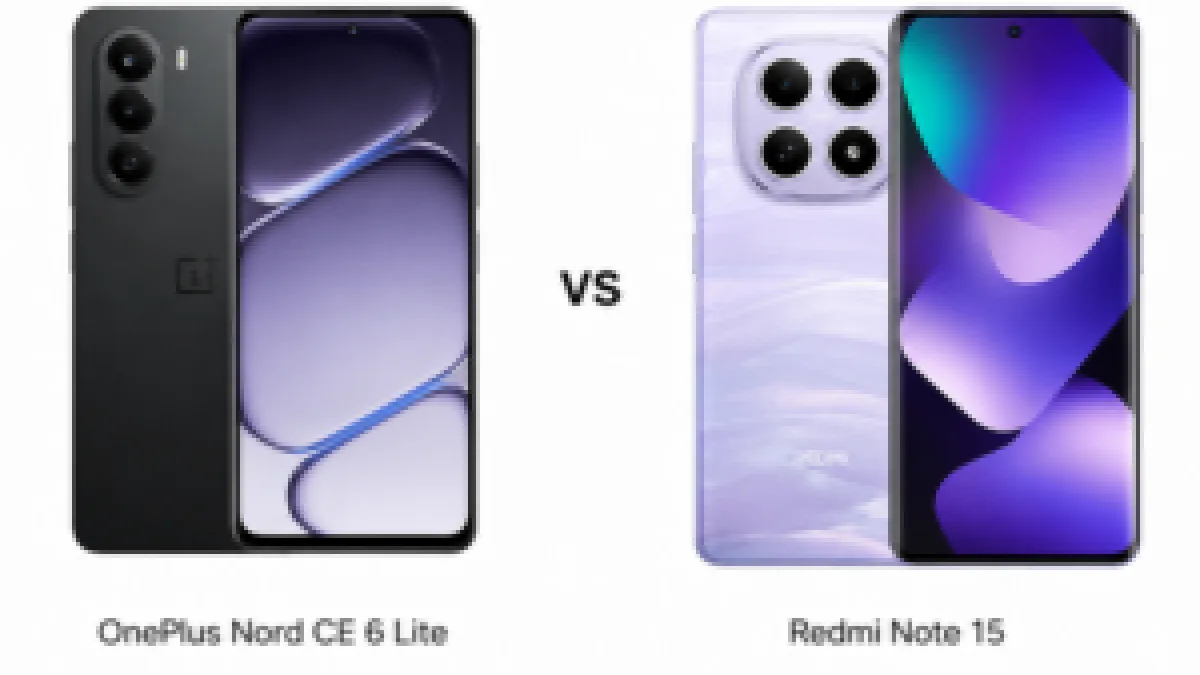
The Redmi Note 15 outpoints the OnePlus Nord CE 6 Lite on display quality, camera hardware, and overall feature count at near-identical prices, though OnePlus holds clear advantages in battery capacity and raw performance.
Display
Redmi’s 6.77-inch AMOLED panel hits a peak brightness of 3,200 nits and supports HDR10+, a high-dynamic-range standard that widens the range of color and contrast a screen can render. The OnePlus Nord CE 6 Lite carries a 6.72-inch IPS LCD with a 144Hz refresh rate — faster than the Redmi’s 120Hz — but the LCD technology cannot match AMOLED’s contrast depth or outdoor visibility.
The Redmi panel also uses 3,840Hz PWM dimming, a flicker-reduction technique that matters to users sensitive to screen strain. For media consumption and everyday browsing, the Redmi screen is the stronger option.
Performance and Storage
OnePlus pairs the MediaTek Dimensity 7400 Apex chip with UFS 3.1 storage — a faster flash memory standard that cuts app load times and file transfer speeds compared to the UFS 2.2 found in the Redmi Note 15. The Nord CE 6 Lite’s Mali-G615 GPU also carries a measurable edge in gaming workloads over the Snapdragon 6 Gen 3’s Adreno 710 in benchmark comparisons, according to chipset specification data from MediaTek and Qualcomm.
For heavy multitaskers and mobile gamers, the OnePlus device responds more quickly under load. The Redmi handles everyday tasks and casual gaming without issue, but storage throughput is the visible gap.
Battery
The Nord CE 6 Lite carries a 7,000mAh battery against the Redmi’s 5,520mAh unit — a 27% capacity advantage. Both phones charge at 45W. OnePlus adds bypass charging, which routes power directly to the processor during gaming sessions to reduce heat buildup on the battery, and 10W reverse wired charging. Redmi offers 18W reverse wired charging.
For Users Who want multi-day battery life or avoid frequent charging, the OnePlus device is the straightforward choice.
Camera
Redmi’s camera system is more complete. The 108MP main sensor includes Optical Image Stabilization, a hardware mechanism that physically compensates for hand movement to sharpen low-light shots and stabilize video. It pairs with an 8MP ultrawide lens. The Nord CE 6 Lite fields a 50MP main camera with an auxiliary sensor but no ultrawide option.
On video, OnePlus records 4K at 30fps and 1080p at up to 120fps — a higher frame-rate ceiling than the Redmi’s 4K at 30fps limit. For selfies, Redmi’s 20MP front camera outresolves OnePlus’s 8MP shooter by a wide margin.
Features and Software
The Redmi Note 15 includes NFC — near-field communication used for contactless payments — an infrared blaster for appliance control, and IP66 dust and water resistance, a higher rating than the OnePlus’s IP64. Xiaomi has committed to four major Android upgrades for the device.
OnePlus ships the Nord CE 6 Lite on Android 16 but has not matched Redmi’s update commitment. The OnePlus device carries MIL-STD-810H certification, a military-grade durability standard covering drops and temperature extremes.
Both phones include stereo speakers. The Redmi adds Dolby Atmos processing.
Pricing
Both devices retail at approximately ₹23,000 in India. Prices vary by region, configuration, and whether the unit is a China-market or global variant. The Redmi Note 15’s feature set — AMOLED display, OIS camera, NFC, infrared blaster, and a longer software support window — represents a broader value proposition for general buyers.
The Nord CE 6 Lite targets a narrower audience: users who place battery endurance and processor speed above display quality and camera versatility.
-

-

-

-

-

-

-

-

