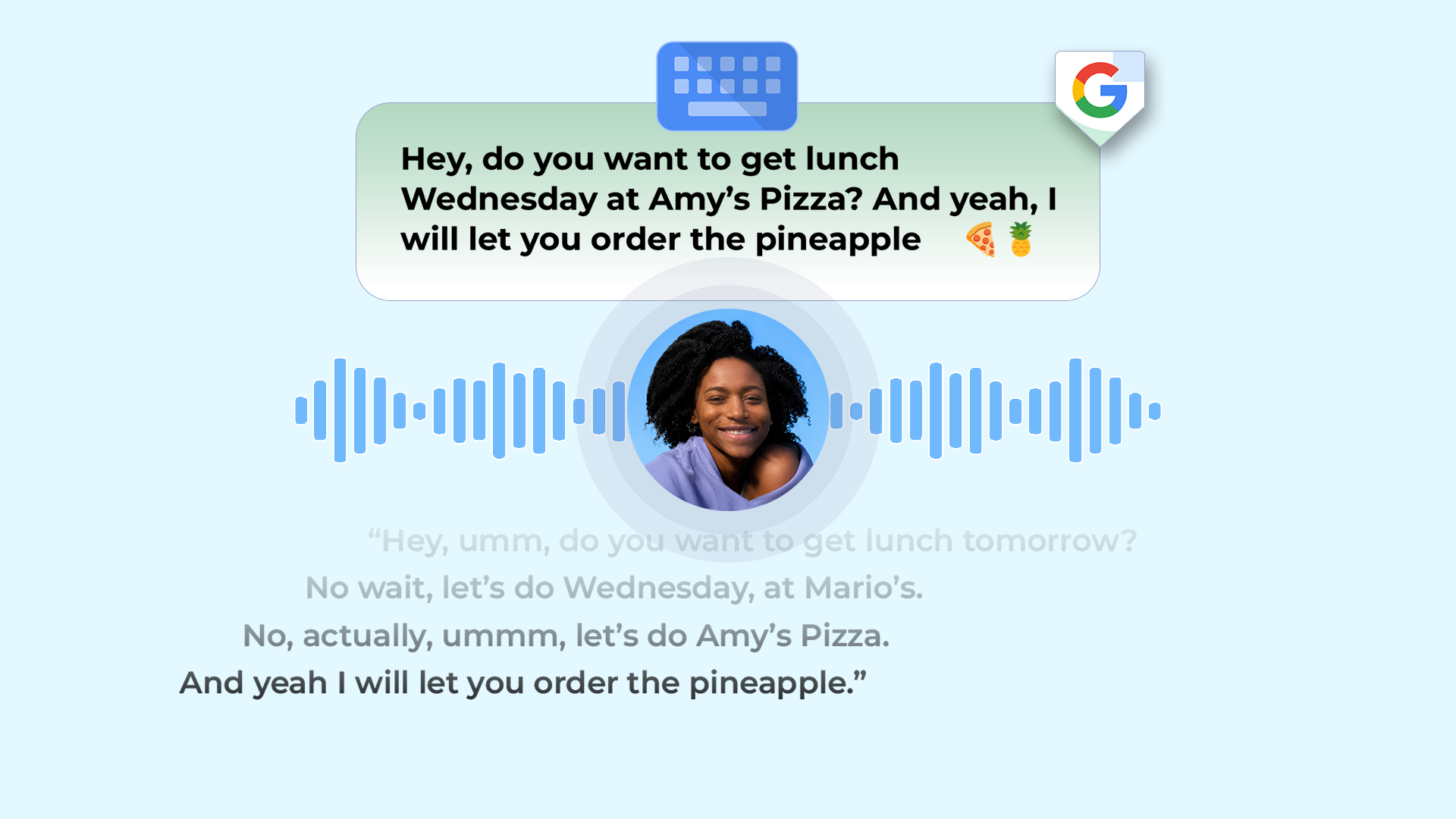
Google is updating Gboard with an artificial intelligence feature that automatically cleans up voice-typed text, removing filler words and restructuring spoken language into readable prose.
The feature targets a long-standing friction point in mobile voice input. Humans speak at roughly three times the speed they type, according to research published in the journal Frontiers in Psychology, but raw voice transcription often produces fragmented, filler-heavy text that requires manual editing before it can be sent.
What the feature does
Gboard’s new AI layer sits between transcription and output. It takes the raw spoken text — including false starts, repeated words, and filler phrases such as “um” and “like” — and rewrites it into clean, natural sentences.
The tool does not simply transcribe. It interprets and restructures, functioning more like an editor than a stenographer.
Google has not yet disclosed which underlying model powers the feature. The company also has not confirmed a firm global rollout date.
Voice input on mobile
Voice typing on smartphones has existed for over a decade, but adoption has remained uneven. Many users start a voice message, catch the raw output, and switch back to the keyboard.
The gap between how people speak and how they want to sound in written form has been the core obstacle. Casual speech is full of restarts, hedges, and redundancies that read poorly in text.
AI-assisted cleanup addresses that directly. Rather than requiring users to edit output after transcription, the feature handles the cleanup automatically before the text appears in the input field.
Gboard’s position
Gboard is Google’s first-party keyboard application for Android and iOS. Google reports the app has more than one billion installs on Android alone, making it one of the most widely distributed input tools on any platform.
The keyboard has steadily added AI-assisted features over recent years. Earlier additions include next-word prediction, smart compose suggestions pulled from Gmail, and real-time translation between languages.
The voice cleanup tool extends that trajectory. It brings generative AI — systems trained to produce human-like text — directly into the transcription pipeline rather than treating it as a separate post-processing step.
Broader context
Google is not alone in pursuing this direction. Apple has enhanced its own dictation tool in recent iOS releases, adding on-device language models to improve transcription accuracy. Microsoft has integrated similar cleanup functions into its SwiftKey keyboard on Android.
Still, Gboard’s scale gives Google a wider immediate reach for any feature it ships. A rollout to even a fraction of its install base would place the tool in front of hundreds of millions of users.
The International Telecommunication Union estimated there were approximately 6.8 billion smartphone subscriptions globally as of 2023, a figure that contextualizes the potential surface area for mobile input tools of this kind.