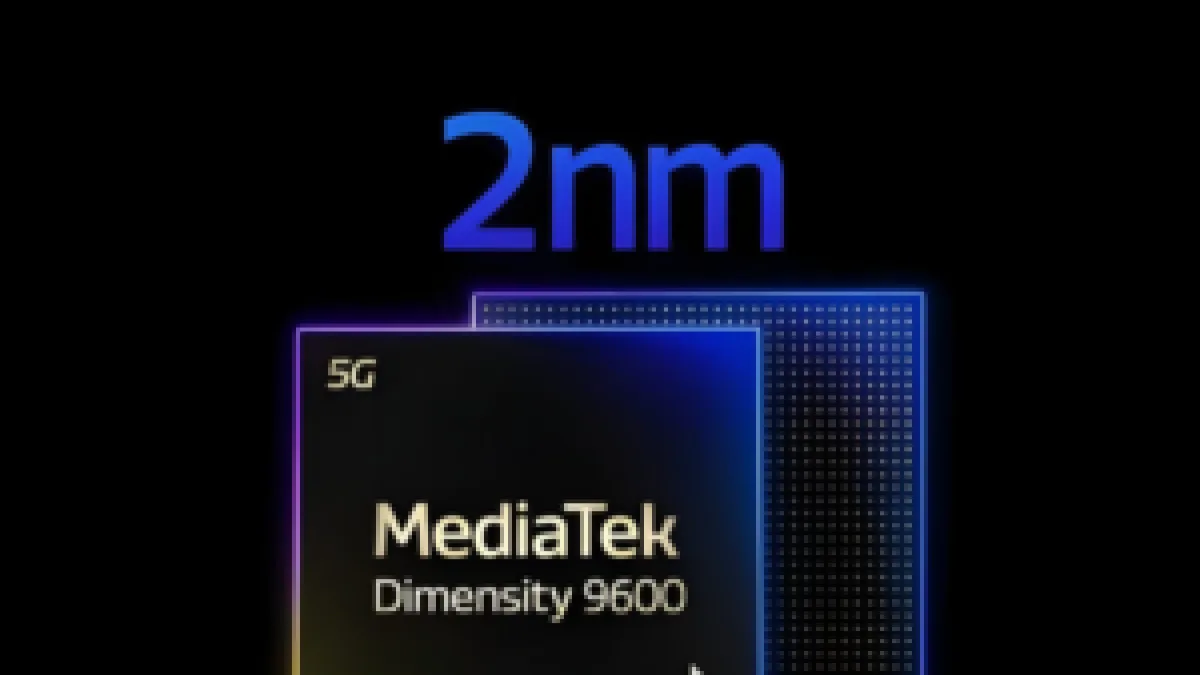
MediaTek plans to launch its Dimensity 9600 chip series in September 2026, with leaked specifications pointing to a significant architecture overhaul aimed at closing the gap with Apple and Qualcomm in the flagship smartphone market.
The company is also expected to introduce the Dimensity 9600 Pro — its first Pro-branded mobile processor — alongside the standard model. MediaTek has not confirmed any details; all specifications below come from leaks and reported tipster claims.
Process Node and CPU Design
The Dimensity 9600 Pro is expected to use TSMC’s 2nm N2P process node, which TSMC says offers a 10–15% performance gain and 25–30% better power efficiency versus its predecessor. Whether the standard Dimensity 9600 uses the same node remains unclear.
Supply constraints at TSMC complicate that question. The standard model may instead use a 3nm node or a lower-binned 2nm variant to manage costs.
Both chips are said to drop the conventional ‘1+3+4’ core layout in favor of a ‘2+3+3’ arrangement. The Pro variant reportedly pairs two Ultra prime cores — codenamed “Canyon” and based on Arm’s next-generation Cortex C2-Ultra — with a peak frequency of 5.0 GHz.
Three performance cores, codenamed “Gelas-B,” sit alongside three balanced cores codenamed “Gelas.” The standard Dimensity 9600 may share this layout but clock lower.
GPU and Gaming
Both chips are expected to carry Arm’s next-generation “Magni” GPU architecture, with the Pro model featuring a higher core count. Ray tracing support — hardware-assisted rendering of realistic light, shadow, and reflection — is expected on both variants.
Leakster Digital Chat Station said the chips include dedicated hardware blocks for gaming workloads, including a frame interpolation feature that can scale a 60 FPS game to 120 FPS at the silicon level. The Magni GPU is also said to handle native resolution upscaling in hardware rather than through software.
The Dimensity 9600 Pro is expected to support LPDDR6 RAM — the next generation of mobile memory — and UFS 5.0 storage, an upgrade from the UFS 4.0 found on the standard model.
AI Hardware
MediaTek is said to be equipping both chips with a dual-NPU (neural processing unit) design intended to split AI workloads across layers of compute. A Neural Shader Scheduler — software that routes machine learning tasks dynamically between the GPU and NPU — is also expected.
The chips may include hardware support for Arm’s Scalable Matrix Extension 2 (SME2), a feature that accelerates the matrix calculations underpinning large AI Models. MediaTek has separately been linked to supplying the chip inside OpenAI’s first AI-focused smartphone, though neither company has confirmed that.
Benchmark Estimates
Digital Chat Station shared early Geekbench 6 estimates drawn from engineering samples — pre-production hardware that typically scores below finished chips. The Dimensity 9600 Pro may score between 4,200 and 4,300 in single-core tests and between 12,000 and 12,500 in multi-core tests.
The same tipster put the Dimensity 9400’s estimated scores at 4,000 single-core and 11,000 multi-core, suggesting a moderate generational gain rather than a sharp jump.
Expected Devices
Four handsets are currently linked to the series: the Vivo X500 and X500 Pro, and the Oppo Find X10 and Find X10 Pro. The first device could reach market as early as September 2026.
Qualcomm is expected to introduce a Pro-tier variant of its Snapdragon 8 Elite successor on a similar timeline, setting up a direct competition between the two chipmakers in the second half of 2026.