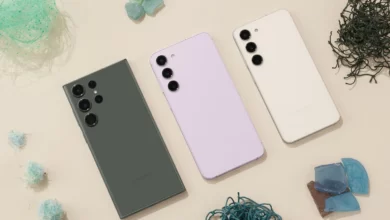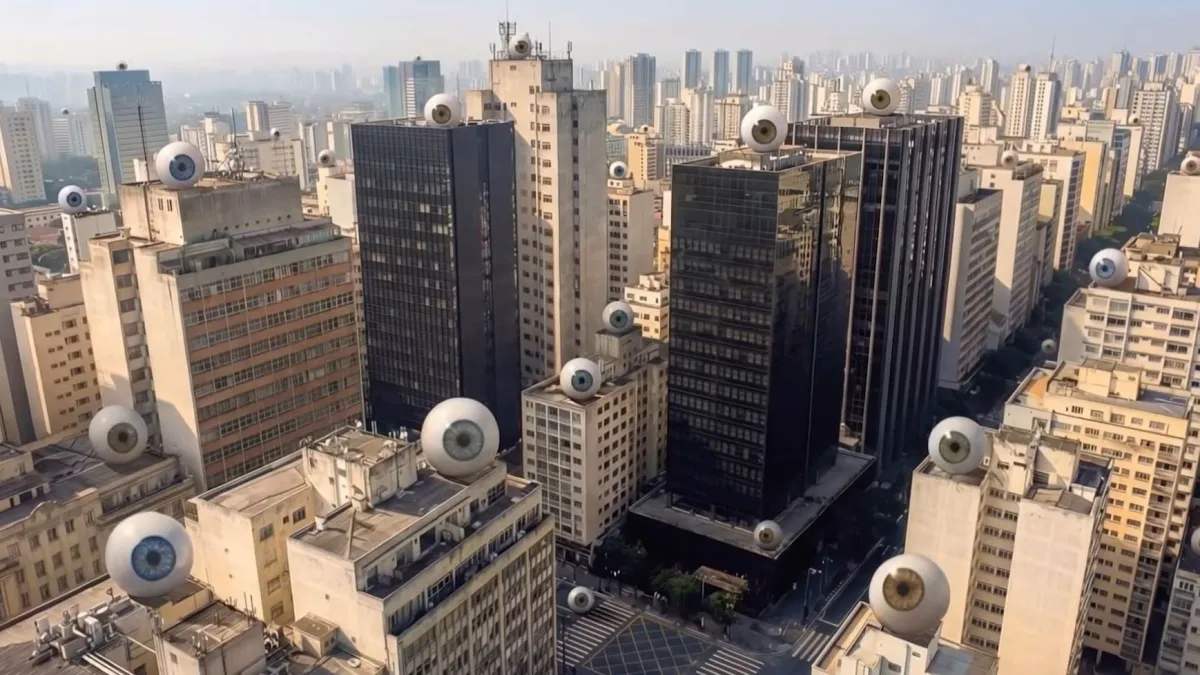
Samsung deployed an unsettling new advertising campaign featuring giant, wandering eyeballs to promote Privacy Display — a screen technology built into select Galaxy devices that narrows the viewing angle so only the person directly in front of the phone can see the content.
The ad leans on a common anxiety: the feeling that strangers on public transit, in coffee shops, or at airports are reading over your shoulder.
What Privacy Display Does
Privacy Display works by reducing the screen’s visible angle sharply, making the display appear dark or washed out to anyone not positioned directly in front of it — similar in function to a physical privacy screen protector, but built into the hardware itself.
Samsung has included the feature across several Galaxy S and Galaxy Z series models, activating it through a quick-settings toggle.
The Campaign
The commercial places oversized, roaming eyeballs in everyday public settings — on buses, in waiting rooms, peering around corners — framing shoulder-surfing (the act of reading someone else’s screen without permission) as an ambient, unavoidable threat.
The creative choice is deliberate. Rather than listing technical specifications, Samsung leaned into visceral discomfort to make the privacy use case feel immediate and personal.
That approach tracks with broader industry behavior. Consumer concern over digital privacy has climbed steadily — Pew Research Center found in 2023 that 67% of Americans feel the government monitors their activities and 79% say they have little control over the data companies collect on them.
Still, those figures speak to data privacy at scale — surveillance capitalism, tracking, data brokers. Shoulder-surfing is a more tactile, physical concern, and Samsung’s ad zeroes in on exactly that distinction.
Competitive Context
Samsung is not alone in addressing on-device visual privacy. Apple integrates software-level Screen Distance and Screen Time controls, though it does not offer a native hardware-level viewing-angle restriction comparable to Samsung’s implementation.
Third-party privacy screen protectors — thin adhesive films that physically narrow viewing angles — remain a large consumer category. Grand View Research valued the global privacy screen protector market at $1.02 billion in 2022 and projected steady growth through 2030, suggesting meaningful consumer demand for exactly the kind of protection Samsung now markets as a built-in differentiator.
By embedding the feature at the hardware level, Samsung positions it as a premium convenience — no film to apply, no adhesive to replace.
Background
Samsung introduced Privacy Display as part of its broader Knox security platform, which the company has used since 2013 to differentiate Galaxy devices in enterprise and government markets.
Knox bundles hardware and software security layers — including secure enclaves, real-time kernel protection, and device attestation — aimed at corporate and government buyers with strict data-handling requirements.
Privacy Display extends that positioning into the consumer mainstream, translating an enterprise-grade concern into a feature marketed through eyeball horror and commuter anxiety.